Here are five ways to improve your experience.
Breathtaking landscapes, nationally-acclaimed attractions, exotic wildlife, and a mild climate make Florida a premier destination for visitors from across the globe. Whether you’re looking to relax on a secluded white sand beach, swim in a crystal-clear natural spring, or hook a tarpon, Florida offers an abundance of magical moments.
October through April brings comfortable temperatures in the 60s to 80s, lower humidity, and lower risk of severe weather. This is when snowbirds fly south for the season and sun-starved holiday and spring break travelers come to lighten up for a week or two. When the roads and campgrounds are at max capacity, a little advance planning and prep work go a long way in preserving your peace of mind. We’ve created a guide to help RVers like you get ready for the adventure ahead, so all you have to do is focus on making memories that will outshine your tan.
Obey the 3-3-3 Rule

It’s easy to be overly-ambious when planning your route. But driving an RV or towing a camper requires greater attention and slower speeds than typical passenger vehicles. Fatigue can set in fast and create stressful situations, which is the exact opposite of the restful vacation you’re after. Don’t be a Clark Griswald; respect your limits and make it easy on yourself (and your passengers) by following three simple rules:
- Limit your driving to 300 miles per day. This keeps your time on the road manageable and prevents physical and mental exhaustion.
- Plan to arrive at your campsite by 3:00 PM. This gives you plenty of daylight to park, level your vehicle, and hook up utilities.
- Spend 3 nights in each location. This slows down your pace, giving you plenty of time to rest, explore, and handle basic maintenance issues.
Book Early. Seriously.

The reasons you want to go to Florida are the exact same reasons everyone else does, too. Its stunning beaches, comfortable climate, and large campground network make Florida one of the most popular RV states, especially in the winter. Plan ahead, waaay ahead, and book your campsites six to 12 months in advance of your stay. If you prefer more spontaneous travel, check to see if there are any last-minute cancellations available. But don’t just wing it and hope to find a place to sleep. That approach leads to more hours on the road and a lot more stress than necessary.
Learn the Road Rules

Visiting The Sunshine State is the laid-back experience you imagine IF you follow the rules of the road. Here are a few things to know about getting around safely and efficiently.
- Vehicle dimensions: In Florida, an RV’s maximum width is 8.5 feet; the maximum length varies by road type and local restrictions. Keep in mind that older roads, bridges, and campground access rules may impose their own limits, so advance route planning is important.
- Towing cars and trailers: Towing a small car behind an RV is permitted in Florida if the combined setup meets state safety requirements, including braking and lighting rules. However, towing regulations can depend on vehicle type, total length, and equipment.
- Rest stops: Highway rest areas allow stops for up to three hours. Overnight parking in unapproved public spaces, municipal beach lots, or retail corridors is heavily restricted by local codes.
- Boondocking: Refers to camping outside of developed campgrounds. In Florida, boondocking opportunities are limited; always check posted signs and local guidance before spending the night.
- Waste disposal: A dump station is a designated facility for emptying RV wastewater tanks. These are typically found in campgrounds and some public facilities. Emptying tanks anywhere else is illegal and subject to fines.
Know Your Options

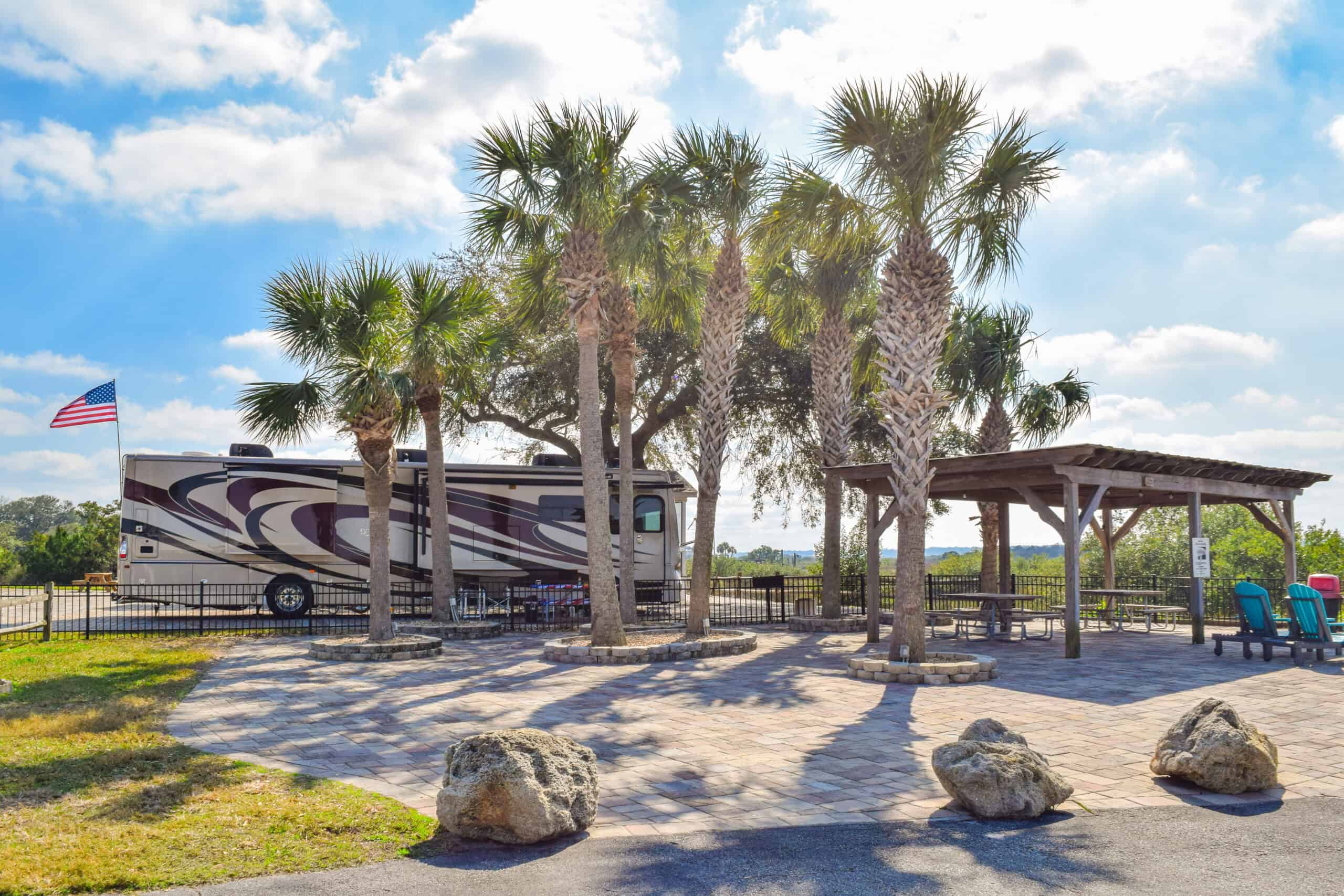
Florida offers a wide-range of RV-friendly campgrounds. Some are luxurious, like Ocean Grove RV Resort, with high-end amenities, an on-site restaurant, and a premier location close to the beach and city center. Others offer a more rustic and off-the-beaten-path experience. Choose your own adventure and remember to book early to snag the best spot and rate. Here are the most common options to choose from:
- Private RV parks: Often include full hookups (water, electricity, and sewer). May offer a range of resort-style amenities like pools, restaurants, gyms, clubhouses, and laundry facilities.
- State parks: The rules for overnight stays, generator use, and length limits vary by campground. Typically, the maximum stay is 14 consecutive days during peak seasons, which can be extended up to 28 days at the park manager’s discretion. Campers must leave for at least three nights after a two-week stay and cannot exceed 56 total nights within a semi-annual window.
- National parks: Many of Florida’s national parks can’t accommodate RV camping due to their water-based ecosystems. However, Everglades National Park does allow RV camping, with a maximum stay of 14 consecutive days during the peak winter season (November 1 through April 30).
FYI:
- Full hookups = electricity, fresh water, and sewer connection at your pitch
- Partial hookups = usually just electricity and water
Research the Regions

The Sunshine State has wowed visitors since the first explorers stepped ashore five centuries ago. Florida offers an array of landscapes, microclimates, and manmade and natural attractions that you can’t find anywhere else. There truly is no place like it and picking “the best” area to explore is an impossible task. Here’s an overview of Florida’s four main regions.
- Northwest: Known as the “Panhandle,” this region is best known for its soft, white-sand beaches and warm, emerald green waters. Along the coast you’ll find a wealth of outdoor activities, including horseback riding, zip lining, kayaking, canoeing, hiking, biking, and all types of watersports. Inland, you’ll find rural lakes, rivers, springs, and parks that offer endless opportunities for outdoor enthusiasts. The largest city in this region is Tallahassee – Florida’s capital and home to Florida State University.
- Northeast: Experience cultural, historic and natural wonders along Florida’s Nature Coast. Wide beaches, scenic rivers, and freshwater springs delight nature lovers. History buffs love to explore the 500-year-old streets of St. Augustine for its hidden secrets and award-winning culinary scene. Catch an unforgettable live performance at the amphitheater in Anastasia State Park, watch a lively football game at the University of Florida, or indulge in an unforgettable dining experience in Jacksonville. This region is unmatched for its distinct beauty and charm.
- Central: This is the land of endless recreational activities, natural and man-made wonders, and world-famous attractions. Orlando is home to major theme parks like Disney World®, Universal Studios®, and Sea World®. Premium outlet shopping, mega malls, the Daytona International Speedway, and the Kennedy Space Center also vie for your attention. Explore top-rated beaches along the Gulf Coast, enjoy quaint coastal towns and bustling big cities, and experience a variety of arts, culture, and sporting events. With so much to do and see, Central Florida caters to nearly every type of visitor.
- South: Welcome to Jimmy Buffet’s vision of paradise. Miami’s lively music and arts scene, festivals, and local cuisine makes it a city unlike any other. Naples and Palm Beach are famous for high-end shopping, Sarasota for incredible beaches, and Sanibel Island for enthusiastic shelling. Walk in Hemingway’s footsteps in the Keys where world-class fishing, a few Papa Dobles, and an applause-worthy sunset round out the perfect day. South Florida is a breath-taking destination for adventurers and beach lovers alike.

Let’s Go!
Now that you have the basics of RVing in Florida covered, it’s time to reserve your stay. Ocean Grove RV Resort has some of the best standard and premium RV sites available for long-term bookings. Inventory is very limited for this winter, so BOOK NOW and claim your spot in the sun.
These extended stays are very popular and we encourage you to book early for the best availability.